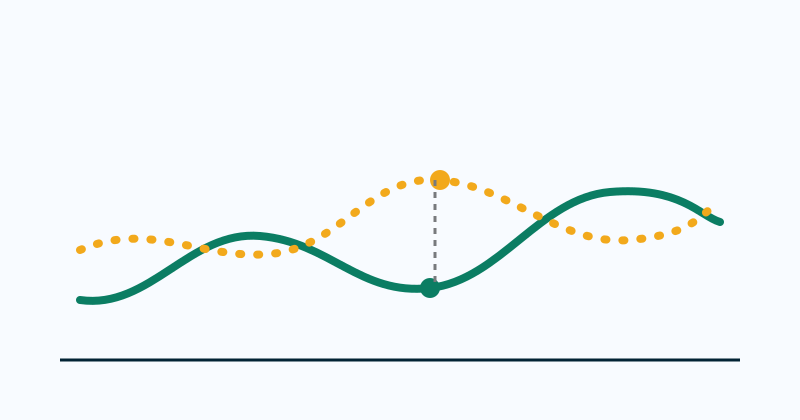
Pull the same domain through Ahrefs and Similarweb and you'll get two numbers that can differ by 5x. Take a mid-sized cooking site: Ahrefs might say 210K monthly organic visits while a Similarweb estimate says 900K total. Neither tool is broken. They are answering two different questions — and the gap between their answers is one of the most useful signals you can get about a website without owning its analytics.
Why the two numbers disagree by design
Ahrefs estimates organic search traffic. Its model starts from keyword rankings: it knows (roughly) which keywords a site ranks for, each keyword's search volume, and typical click-through rates per position. Multiply through and you get an estimate of visits arriving from Google's organic results — and only those.
Similarweb estimates all-channel visits. Its model is built from browsing panels, clickstream data and measurement partnerships. It tries to count every visit: search, direct, social, referral, email, paid — the whole front door, not just the organic side entrance.
So for almost any domain, Similarweb ≥ Ahrefs is the expected state. If you've been treating the difference as an error and picking whichever number suits the slide, you've been throwing away the signal.
The ratio is the insight
Divide the Ahrefs organic estimate by the Similarweb total and you get a rough organic share — the fraction of a site's audience that arrives from search. That single ratio tells you what kind of site you're looking at:
| Organic share (Ahrefs ÷ Similarweb) | What it usually means |
|---|---|
| ~70–100%+ | A pure SEO site: rankings are the business. (Above 100% happens — both are estimates.) |
| ~35–70% | Search-led but diversified: content brand with direct and social legs. |
| ~10–35% | Search is a side door: brand-navigational, social-heavy or paid-heavy traffic mix. |
| Under ~10% | An audience that mostly doesn't come from Google: apps, communities, big consumer brands. |
A worked example, with illustrative figures for four familiar kinds of domains:
| Domain type | Ahrefs organic | Similarweb total | Share | Read |
|---|---|---|---|---|
| Recipe/content site | 820K | 1.1M | ~75% | SEO is the engine. A Google update is an existential event. |
| SaaS with a strong brand | 140K | 600K | ~23% | Most visits are navigational/direct. SEO is an acquisition channel, not the moat. |
| News publisher | 2.1M | 9M | ~23% | Home-page loyalists and social dominate; search brings the long tail. |
| Niche tool directory | 95K | 90K | ~100% | Effectively all search. Also a hint the Similarweb panel undercounts small sites. |
Figures are illustrative, not measurements — they show the shape of the analysis, which holds regardless of the exact numbers you pull.
What each estimate is better for
Trust the Ahrefs number more when you're evaluating SEO specifically: link prospecting, judging whether a site's rankings are real, estimating what a #3 position is worth in a niche. It's keyword-attributable — you can see which queries the traffic comes from.
Trust the Similarweb number more when you care about total audience: sponsorship pricing, competitive sizing, "is this brand actually big or just good at SEO?". Panel-based estimates get stronger as sites get bigger; they're weakest on small, low-traffic domains, where the panel simply hasn't seen enough visits.
The workflow: check both, every time
The mechanics used to be the annoying part — two tools, two logins, two exports, one VLOOKUP. The procedure itself is short:
- Pull both estimates for the same domain list, on the same day, from the same sources.
- Compute organic share per domain.
- Flag the outliers in both directions — shares near 100% (SEO-dependent, fragile to updates) and shares under ~15% (search barely matters; don't pitch them SEO value).
- When the two estimates disagree wildly on the trend — one says growing, the other collapsing — dig in before you believe either. Usually one dataset lags the other by a month or caught a redesign/migration mid-flight.
This side-by-side view is literally why our API returns both estimates in one response —
organic_monthly_visits next to monthly_visits, each stamped with its
provider and fetch date. You can pull it for any domain via the
API and wire it into a sheet; the
free checker shows one provider per check.
Reading disagreement as signal
The last mental shift: stop asking "which number is right?" Neither is. They are two independent models of an unobservable quantity, and their relationship is more informative than either value alone. Two estimates that agree on direction give you confidence. Two that diverge tell you something changed in how a site gets its visitors — often before either number alone would have told you anything at all.